



Two articles in one week is very unlike me. But the evidence piling up about Alpha School over the past two weeks has me convinced I got something important wrong, and the least I can do is say so publicly.
Not everything, mind you. Some of what’s coming to light actually confirms a couple of things I called out a year and a half ago in my prediction article, and I’ll get to that. But the part I got wrong is arguably the most important part of this whole experiment. In Motivation Is All You Need, which I still consider one of my most original pieces, I described what I called Alpha’s “secret sauce.” That’s the part I got dead wrong, mostly because I did not assume unethical behavior.
It’s not like I hadn’t been warned. My anti-AI reading diet (yes, I read a lot from people who hate AI) had served me plenty of credible criticism, from Dan Meyer, Benjamin Riley and Dylan Kane in particular. I’m not going to rehash all the problems here. Riley is doing that job very well and you should go read him if you’re curious. His series starts out fishy, then goes from car crash to train wreck, to train wreck with hazardous cargo like East Palestine, and is currently heading toward full-blown Chernobyl.
What I want to do here is simpler. Lay out what I said, what I predicted, where the two just collided, and what I still don’t know.
What I said
Until a few weeks ago, this is how Alpha was described in most of the media: a private school where kids spend two hours a day on an adaptive, “AI-powered” mastery app, then the rest of the day on life-skills workshops. No teachers, but well-paid “guides.” Test scores in the 98th percentile on NWEA MAP. That was the story Alpha told, the story most outlets repeated, and the story I reacted to.
Here’s what I wrote about it in April:
“This all-in AI school making headlines with only 2 hours a day of academic work and achieving 98th percentile across subjects does indeed have a secret sauce — but it ain’t AI.”
So far so good. I never bought that the software was doing the work. But I didn’t buy the easy counter-explanation either. When Dan Meyer posted about the 404 Media investigation back in February, I asked him if he had a theory for Alpha’s results. His answer: “Selection effects. Rich kids doing rich kid things. Next question.” I pushed back:
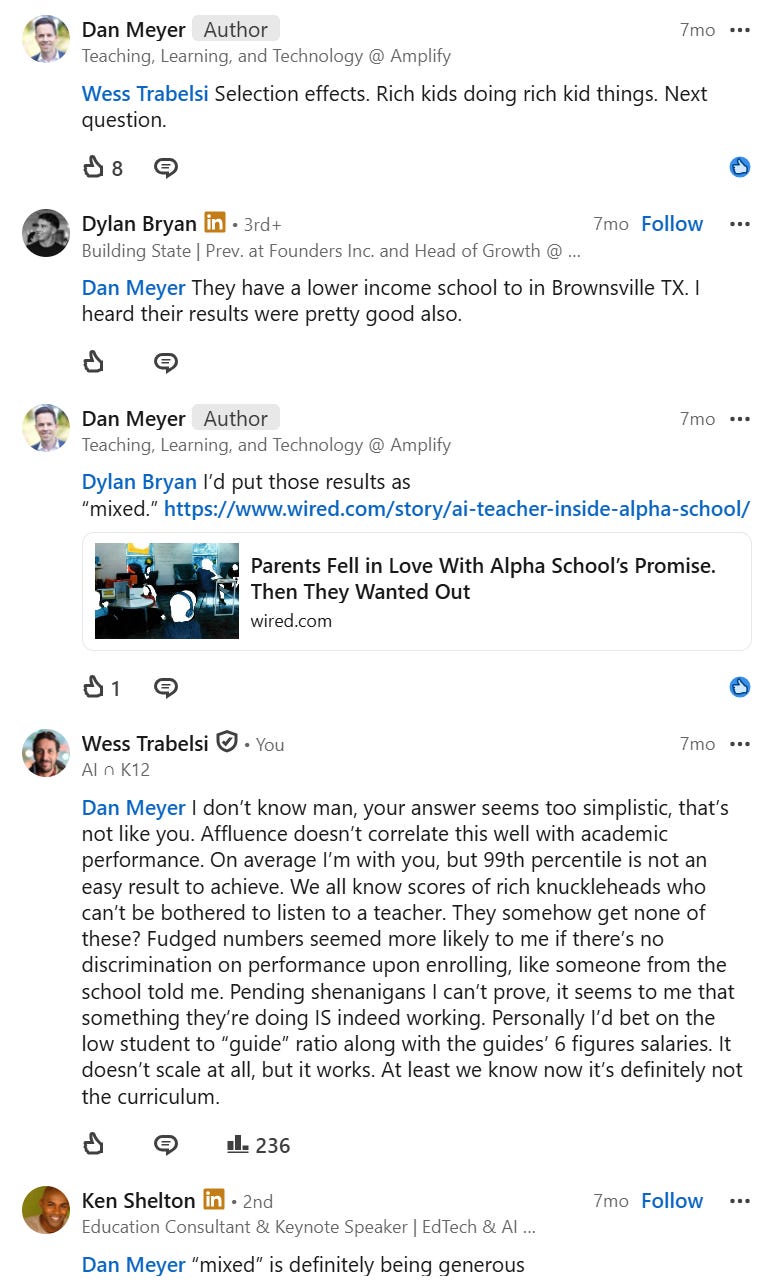
A quick correction on that number while I’m at it, since I threw it around in both places. I went back to the MAP report I was citing. It’s one school year, about 150 kids, preschool through 8th grade, and the 99th percentile is the school’s average ranked against other schools’ averages, not each kid’s rank. More importantly, the kids were already at that level on the September test, before the year started. What actually needs explaining is the growth, not the percentile: in the early grades these kids gained about twice what kids starting at the same level typically gain. I should have been looking into that instead.
Two months after that LinkedIn exchange, I put my theory in writing. This is the passage I now have to eat:
“Even though the school doesn’t employ ‘teachers’ but ‘guides’ — quotation marks necessary — students still conference with actual teachers when stuck on content. These teachers are subcontractors, is all. The guides, who do not technically have to be certified teachers to get the gig, are paid an absolute minimum of $100K a year, and their job is to keep the kids motivated. Happy, well-paid, competent adults with an 8:1 student ratio — that is the secret sauce that explains their results. I’m not dissing here. What they’re doing is legitimately impressive, and these kids are lucky, I think.”
These kids are lucky, I think. Riley’s published student testimonials are nominating this statement for the international cringe awards.

Where did the “conference with actual teachers” bit come from? A conversation at an MIT event with someone working on Alpha’s research side at one of the newer campuses. Same person who assured me, face to face, that they don’t screen for academic achievement at enrollment. It was a great conversation we had; no reason to doubt what he was telling me.
What I predicted
Back in May 2025, I tried to spell out what an AI tutor would need in order to come anywhere close to a human one. Text isn’t enough: if the student goes quiet, the bot has no idea whether they’re thinking hard or gone to the fridge. So I listed the inputs it would need:
“Seeing the student’s work: Real-time screen capture. It exists. Seeing the student: Webcam feed for facial expressions, gaze, and body language. Not creepy at all…”
My prediction was that this kind of fully multimodal tutor would not be a scalable reality in K-12 before 2030, because processing live video and audio from millions of kids costs an astronomical amount of compute and energy.
I was right about the inputs and the compute. What I failed to imagine is that you could offshore work that’s too expensive for AI. I’m still not sure that last sentence isn’t breaking some axiomatic law of Nature…
What Riley reports
Since September 8, Benjamin Riley has published four reports (one, two, three, four) built on students’ public posts, Alpha’s own boot camp material, interviews with former parents, and interviews with former students across several grades and campuses. I have no way to verify that these accounts represent the typical Alpha experience, and Riley himself suspects that things differ between the original Austin campus and the newer ones. Alpha hasn’t answered his requests for comment (here and here). So read what follows as what former students and parents told him, not as established policy.
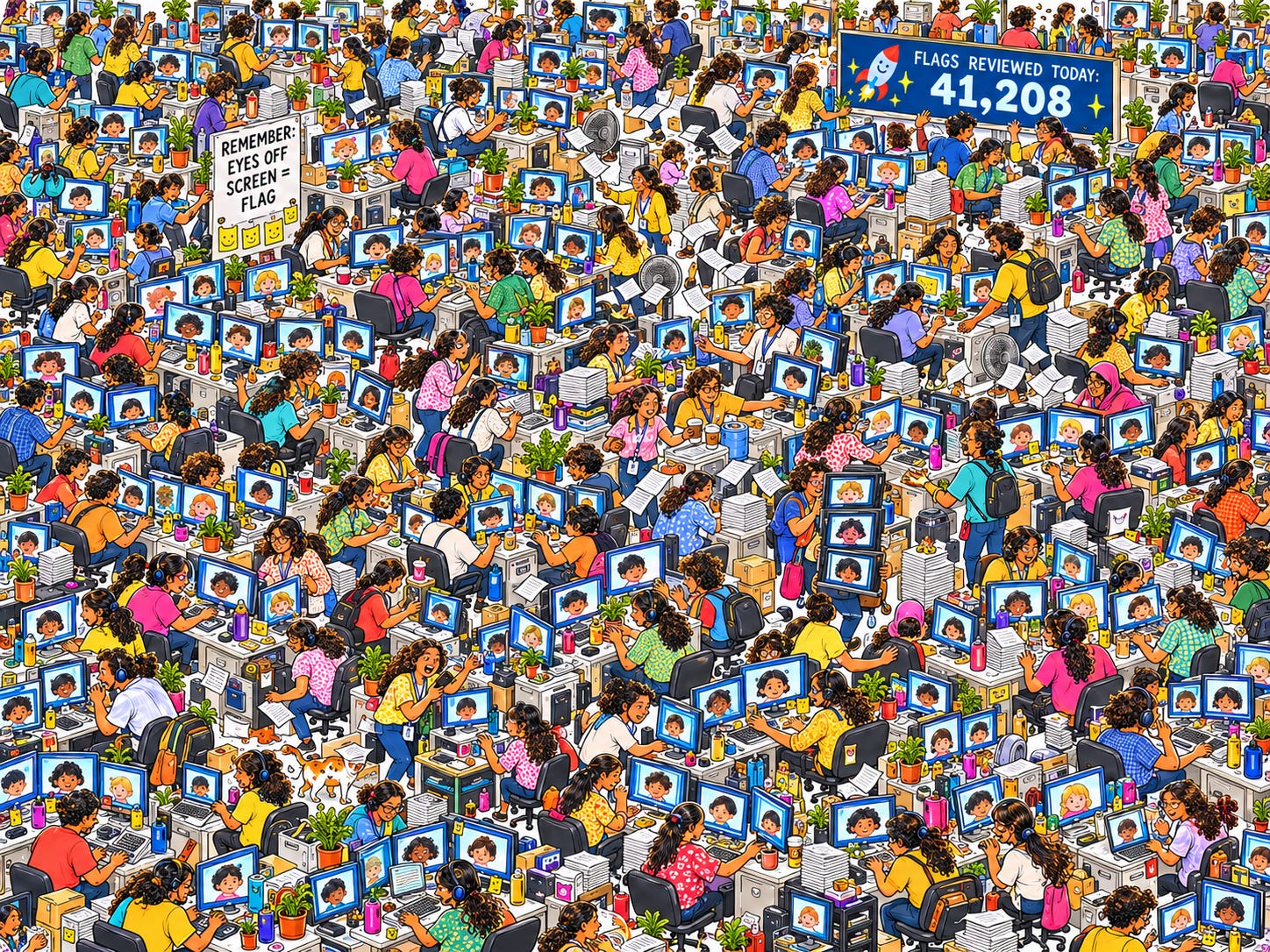
Here’s what they describe. Students say they had to keep the camera on at all times. An AI system read their facial expressions and flagged “anti-patterns”: eyes drifting from the screen, wrong kind of engagement with the app. Behind the AI, a data team outside the U.S. watched them through their computers. Students couldn't tell which one was making the call. Alpha’s own consultant Carl Hendrick describes the intended design as cameras on, AI monitoring behavior and focus, then “producing a report for a human tutor.” One student said the AI told her every day she looked sad, “which is fair because I was really sad, because I was crying every single day.” Another found you could beat it by jiggling the mouse. Miss your accuracy or completion targets, and the computer locks itself to the learning app and displays a mushroom cloud: “You’ve been nuked.” Neither students nor guides could undo it. You waited for the offshore software team, sometimes a full day. Kids who got stuck were sent to remote tutors over Zoom, often in India, while, as one observer put it, “the guide is standing right there.” Several parents said guides were explicitly told not to help with academics during TimeBack. Alpha calls that “grit” apparently. One Austin parent said their guides helped anyway.
Then there’s the sorting. High performers made it into “Rocket Ship”: snacks, special rooms, field trips, relaxed attendance. Underperformers got demoted into “Pirate Ship” rooms, separated from their peers during the fun part of the day, some of them for good. At the high school, students who questioned the system describe a version called “Omega.” One former student said it felt “like a lab rat rather than someone that cared about my learning.” Another: “I was a guinea pig, and I knew that I was a guinea pig.”
So, by my current count, there are at least three sets of adults in this model…? The guides in the room, who by one parent’s account see the academics “through the data on the Dash” and are told to stay out of it. The tutors on Zoom. And the data team on the other end of the webcam, reviewing whatever the AI flagged. The well-paid adults were real, I just had their job wrong. I figured their free hours went to encouraging kids; the people who were there say they went to enforcement.
That’s the literal Big Brother of this story.
Where that leaves me
I still think motivation is the variable everyone ignores, and I still stand by the research argument in Motivation Is All You Need. What I got wrong is which kind of motivation Alpha runs on. In April I argued that extrinsic motivators are dead and intrinsic motivation is the only engine we have left. Reality looks a lot closer to something I wrote in my Cognitive Superloading piece:
“No matter how good AI gets at explaining something or adapting to a student, it cannot do the learning for them. Students learn when they care, or because they’re motivated to achieve, or because they’re threatened otherwise. That final piece of wisdom was recently bestowed upon me by a native from the Soviet Union who told me that when you threatened people with the gulag, a surprising number of them actually managed to become nuclear scientists. I took it at face value.”
If Riley’s sources are right, Alpha found the second and third engines, pointed a camera at them, and called it AI. The growth numbers might even be real. That doesn’t make the model any less toxic.

What I still don’t know
I’m not going to investigate Alpha, but there are a few questions I’d want answered before anyone calls this model effective, let alone useful.
Is Meyer right about the rich kids? Partly, and I’ll give him this: at five years old, a test mostly measures the home. Books, conversation, a parent with time. Money buys that, and Alpha’s kindergartners do arrive at the top. But money doesn’t keep a kid there. It takes a few years of boring school to make a rich “knucklehead”. Alpha’s own report fits that story better than his: the growth advantage is biggest in the youngest kids and fades grade by grade, until by 8th grade reading it’s ordinary. If wealth were doing the work, the older kids would look just as good, but they don’t. Something in this model works on kids too young to have opted out, and works less on kids old enough to have opinions. That’s a motivation story more than a money story, but maybe I’m just wrong again.
Where were these kids when they first walked in? Alpha’s report shows them at the top in September, but most of them were already Alpha students the year before. If a kid arrived in 3rd grade at the 60th percentile and is at the 99th by 6th, Alpha earned that, and the report would hide it. The one number that would settle the selection debate is the entry score, and Alpha hasn’t published it.
Who’s still there in May? The growth numbers only count kids who took both the fall and spring test. Anyone who left mid-year disappears. If kids who struggle get “nuked,” sorted into Pirate Ship, and eventually pulled out by their parents, then the spring report is a report on the kids the model worked for.
Last but not least... It still seems logical to me that rich parents of struggling kids would swarm a “2x learning” school at least as fast as rich parents of gifted ones. Those ones have a problem to solve, so they must be showing up. What happens to their kids?
I looked past the software, and I was right that adults were doing the work. I just got the work wrong. And maybe I should have seen it coming: a leadership that requires teenagers to get 100 followers on X, a founder who, in his former students’ words, “was more after the ideas of the students, profit-wise, than the actual learning,” a kid-sorting hierarchy with a mushroom cloud for a failure screen. Maybe it’s the story my confirmation bias was waiting for all along. I don’t have definitive knowledge, and I won’t pretend I do.
But this much I can say: if I ever harbored wishes that I could send my kids there, those wishes are done evaporated now.
Wess, I'm both grateful and relieved to read this essay. I wish I had the time to write a longer response here, but I don't, so I'll just say instead that many of my sources didn't know about the reality of Alpha School. Until my investigation, I didn't either. Given what's now come to light -- and there's more forthcoming -- I'm hoping more people follow your lead and reevaluate their beliefs about this sinister operation. Children are at risk. Thank you for having the courage to see what is plainly in view, and revising your opinion accordingly.
The initial boost in early grades followed by middle-school fade-out isn't just a motivation story. It reflects the shift from basic rote drill mechanics to complex conceptual synthesis. You kids can be gamified into compliance while acquiring basic knowledge (10x10=100). Older kids outgrow the token economy and hot conceptual walls that the software can't bridge (like logic and rhetoric).
Struggling students have their issues reframed as a lack of "grit" and are subtly counseled out. If struggling kids drop out before spring testing, the growth metrics reflect survivor bias, not pedagogical efficacy.
To your point on motivation and model efface, there is another operational question worth asking: what happens to cognitive momentum when a student actually gets stuck? IN a model replacing teacher with guides who are specifically forbidden from teaching, a student hitting a wall can't raise their hand for immediate, in-person diagnostic help. They have to pause the material, log into a queue, and book a video call with a remote International teacher that often takes place 24 to 48 hours later. The cost of that latency is massive. Immediate in-person feedback corrects misconceptions in seconds. An asynchronous 48-hour delay shatters context, forces task-switching, and leaves the student stranded. The grade-by-grade fade-out you highlighted might simply tack the exact age where material becomes too complex for app-based self-remediation, making that 48-hour help delay fatal to learning.