
Cognitive Superloading
It's a thing.

I swear I wasn’t trying to write another 5,000-word piece. But what I found in my research wouldn’t fit anywhere smaller, and I think it earns the length. By the time you’re done, you’ll have solid scientific references that just dropped, and some genuinely eye-opening data from the business world that I haven’t seen anyone in education talking about yet.
It’s also been a while since I zoomed out on AI itself — where the technology actually is, and what people are doing with it in the real world. This is that piece.
Go grab a coffee, find your reading spot, and let me know what you think in the comments.
I’ve been thinking a lot about this concept of “cognitive offloading” that we all seem to have tacitly accepted as real. Don’t get me wrong, it’s a great metaphor, eminently pregnant. I myself have used it in the past. As a matter of fact, do you know when you first encountered it?
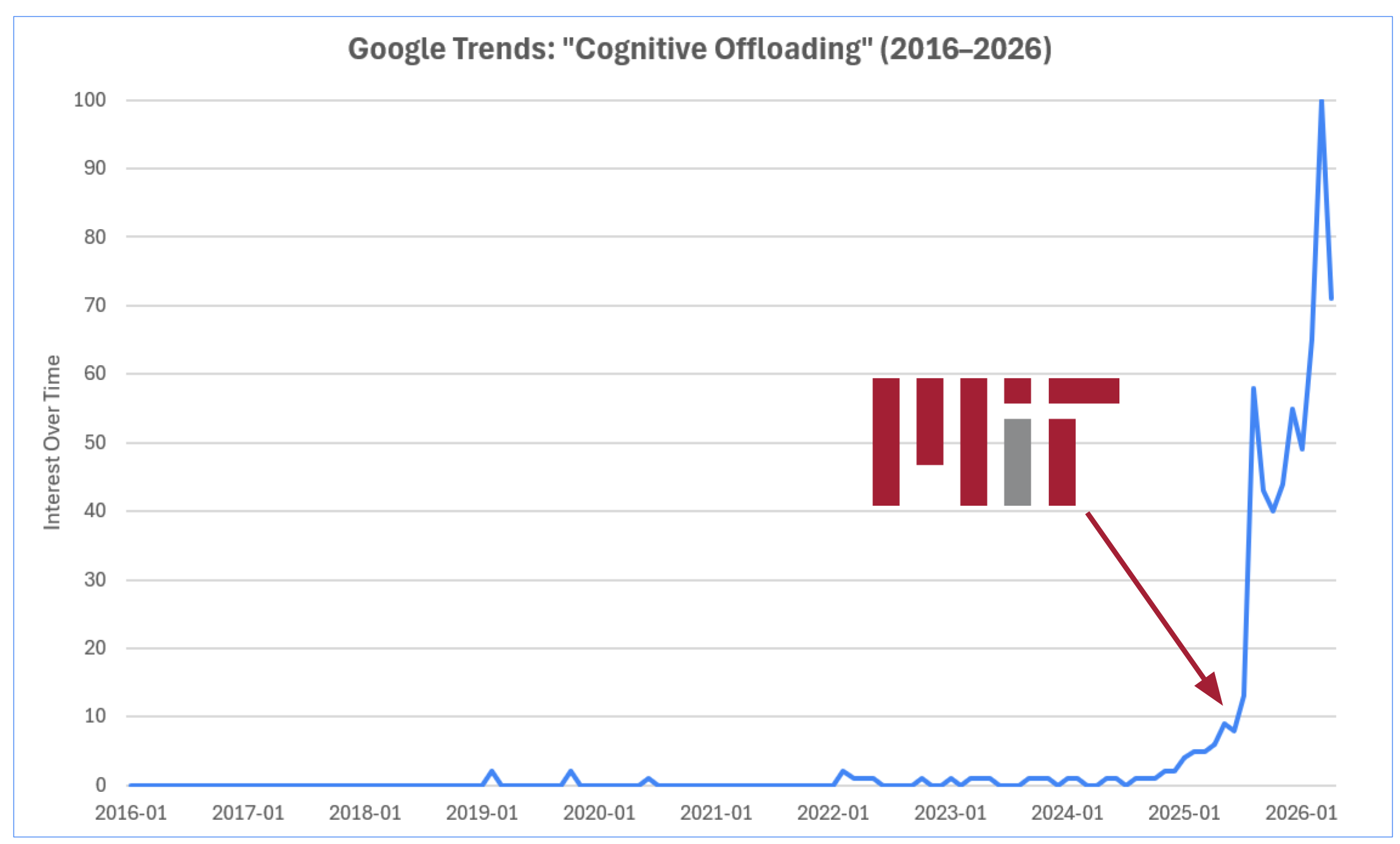
For myself and a number of other people, it was in the MIT paper of June 2025 titled Your Brain on ChatGPT. For you it may have been in the numerous articles written about it, or even in mine. But however it reached you, at some point you nodded along and accepted it as real, just as I did. And that’s exactly the problem — or rather, the opportunity1 — because I’ve been sitting with this concept long enough to ask two questions that I haven’t seen anyone else ask.
The first: does it actually hold water? Is cognitive offloading a real phenomenon, or just an elegant metaphor that we’ve all agreed to treat as fact? And since I don’t want to spend 5,000 words defining every term (such as the difference between cognition, thought, or consciousness), I’ll hereby decree that a new verb shall exist: to cognit.
cognit (ˈkɒɡ.nɪt), v., intr. & tr.
To perform an act of cognition.
As in: “I’m sorry, could you repeat that? I was busy cogniting.”

So the question becomes: can using AI actually make you cognit less? And if used this way, what does it do to your general ability to cognit?
The answer to the first question, as far as the research goes, is yes. And the subtext is that the answer to the second question is that it reduces your general ability to cognit. That’s what’s behind another metaphor used in the MIT paper: cognitive atrophy — and what most people are rightly really concerned about.
Let’s leave aside this second metaphor, forget to ask ourselves if this “atrophy” actually corresponds to a physiological phenomenon, and stick to this outsourcing of cognition for a minute, because to me that’s where the most interesting question lies — the one nobody’s asking.
If a tool can make you cognit less, because it’s doing the cognition so you don’t have to, then mustn’t it logically follow that the same tool could allow you to cognit more?
Why wouldn’t the same mechanism, leveraged differently, enable levels of cognition simply unavailable to our carbon-based brains operating alone?
Now I have you in a pinch. If you accepted cognitive offloading as a real danger of AI use — and most of you did — you must now accept that the same dynamic could allow users to achieve more than they ever could on their own. My argument is that this is not just possible but already happening, that people who can do it will be far more valuable in the workplace, and lastly that it is something schools are not even remotely prepared to address.
But first, let’s look real hard at the root concept — because if cognitive offloading turns out to be just a metaphor with no real mechanism behind it, this entire article collapses. And so does most of the panic around student use of AI, for that matter.
Part 1: Cognitive offloading, a brief history.
I didn’t pick 2016 at random for my Google Trends graph above. While the term wasn’t coined by them, it is definitely Risko and Gilbert who formalized the concept in their 2016 paper of the same name. And I use “formalized” deliberately, because they themselves admit upfront that the term “has long existed in the conceptual repertoire of cognitive scientists, and the phenomenon it refers to is ancient” (page 676). So we’re not talking about a discovery — we’re talking about someone finally building a fence around something that had been roaming free for decades.
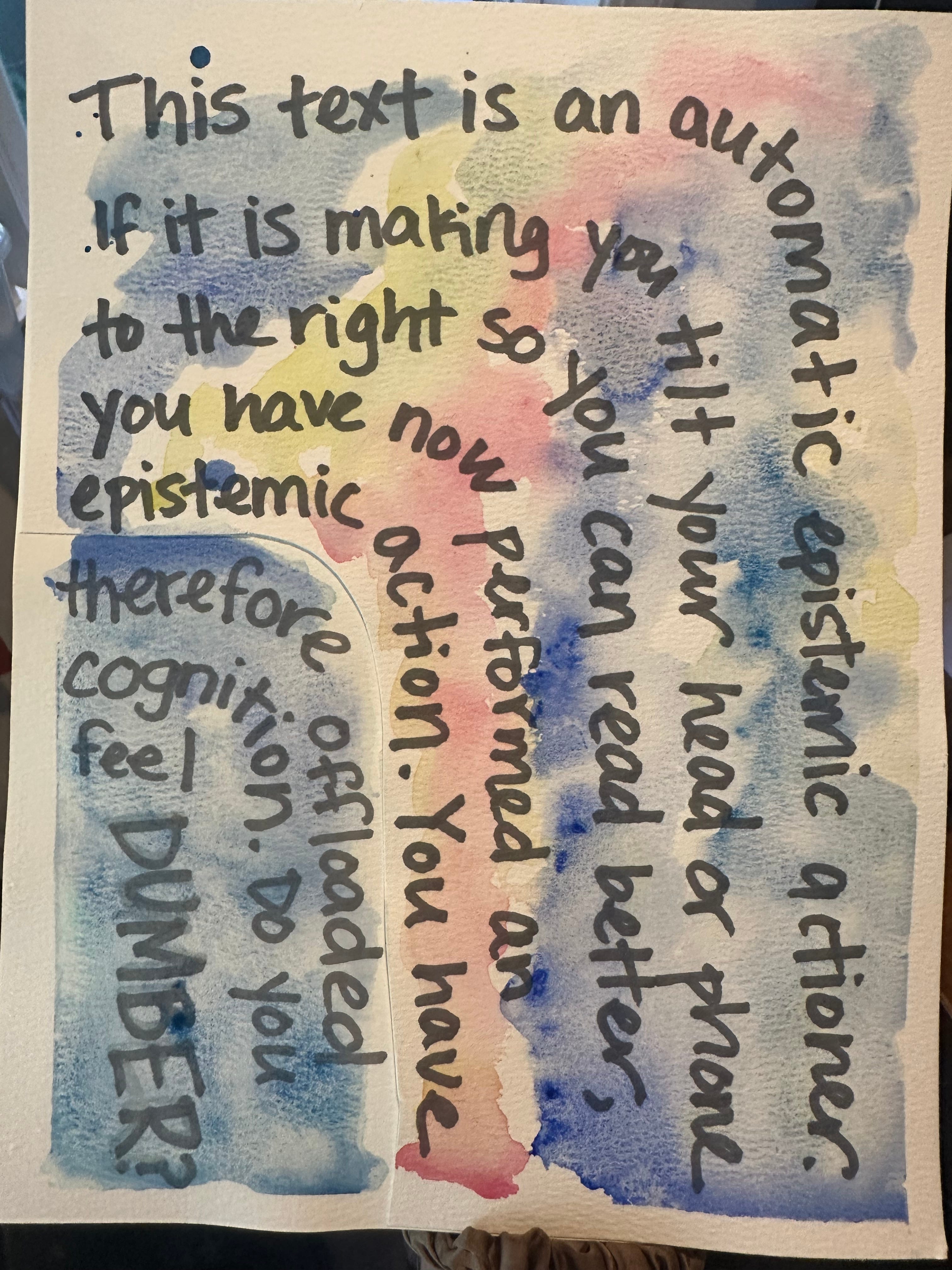
That fence had been slowly assembled by others. Clark and Chalmers argued in 1998 that when you tightly couple with an external tool — a notebook, a calculator — that tool isn’t just helping you think, it becomes part of your “cognitive system”. Hutchins showed in 1995 that a ship’s navigation crew wasn’t really a group of individuals using instruments — it was a single distributed cognitive system, spread across people and artifacts. Wegner had already proposed in 1985 that groups of people function as shared memory banks, each person storing what the other doesn’t bother to. And Kirsh and Maglio, studying Tetris players in 1994, noticed that people were physically rotating blocks on-screen rather than mentally rotating them — because the motor action was cheaper than the cognitive one. They called these “epistemic actions,” and that observation is the seed of everything that follows. Read this:
What Risko and Gilbert did in 2016 was pull all of this together and point at the common thread: humans, when given the option, will consistently choose to move cognitive work out of their heads and into the world. Not because they’re lazy — though that’s part of it — but because the brain is, in their words, a “cognitive miser” (page 681). It runs a constant cost-benefit calculation, and when the perceived cost of thinking something through internally exceeds the cost of reaching for a tool, it reaches for the tool. Every time. Automatically. Often without you even noticing.
The follow-up question — why do we reach for the tool when we do? — was answered three years later by Boldt & Gilbert, who showed that the trigger isn’t just difficulty. It’s confidence. Specifically, the lack of it. We offload not when a task is objectively hard, but when our internal sense of our own ability drops below a threshold. Which means the offloading decision is metacognitive — and that judgment is, as they put it, “potentially erroneous.” We sometimes offload when we didn’t need to. We sometimes don’t when we should have.
That’s the machinery behind the metaphor. And it matters, because the 2026 version of “cognitive offloading” — the one being used to panic about AI — has quietly stripped out all of this nuance and replaced it with a much simpler story: AI does your thinking, you get dumber. Which is exactly what we’re about to interrogate.
Why Wess says the science is wrong
Before I bring in the cavalry, let’s recap why I keep yelling that the very few solidly built empirical studies looking at student use of AI do not actually prove AI makes you dumber. It has to do with the tasks themselves. What almost all the studies have in common is this: first, they eliminate non-compliance from the control group, which means participants in the AI group are compared only to those in the control who successfully followed all directions and performed the task unaided. Participants who drop out are eliminated from the data without due process, and their performance — or lack of it — is not accounted for in the control group’s numbers. This often turns out to be a non-negligible fraction of the sample. In the real world, that would equate to giving a test to your class while your bottom quarter of performers are watching a movie and won’t be included in your class average.
Second, every single study provides AI to the experimental group to complete a low-stakes, boring task that no one could care less about, while the ridiculously low compensation — course credit or a cash stipend under $15 — is not contingent on performance. In order to remove the motivation confound, researchers make sure there is none at all.
When we look at the studies this way, and read what Risko and Gilbert found when they explained cognitive offloading, the choice by study participants to disengage from the task suddenly appears to be a very rational one. In a sense, their research and definition of cognitive offloading actually proves my point — which is this: students in these experiments aren't misusing AI, and they're not failing to learn because something went wrong with the tool. The tool is working exactly as intended. It's absorbing a cognitive load they were never motivated to carry in the first place. You cannot design a study that removes the stakes, removes the motivation, and hands students a frictionless off-ramp — and then conclude that the off-ramp causes the problem. It could not be otherwise, and unless this is addressed in the study design, science is doomed to always find the same predictable result. No matter how good AI gets at explaining something or adapting to a student, it cannot do the learning for them. Students learn when they care, or because they’re motivated to achieve, or because they’re threatened otherwise.
That final piece of wisdom was recently bestowed upon me by a native from the Soviet Union who told me that when you threatened people with the gulag, a surprising number of them actually managed to become nuclear scientists. I took it at face value.
Why new science suggests I’m on to something…
Last week my confirmation bias fired up on all cylinders for about 48hrs. I read this excellent article by Dr Philippa Hardman, and learned about a couple new studies that very strongly align with what I’ve been saying. I say “align” and not “prove” because no matter how much I wanted it to be true, careful analysis of the papers do not allow me (yet) to declare victory. That would be my one criticism of Dr Hardman’s article which is otherwise outstanding. If you like my writing, you should check her out.
The first paper is Lodge’s & Loble’s Artificial intelligence, cognitive offloading and implications for education, published last month, which draws a distinction between beneficial and detrimental offloading — the impact of AI on learning depends entirely on what’s being offloaded and why. Offload the extraneous stuff, the grammar check, the formatting, the lower-order busywork, and you free up working memory for deeper thinking. Offload the actual reasoning and you’ve just skipped the learning. Same tool, completely different outcome depending on the task.
They have empirical support for this. Hong et al. (2025) explicitly taught students to delegate lower-order writing tasks to AI while keeping their own cognitive effort on higher-order analysis and evaluation. That group significantly outperformed controls on critical thinking measures. When offloading is intentional and task-specific, it doesn’t just protect learning — it accelerates it.
That’s not a warning about AI. That’s a proof of concept. And it’s exactly what I’ve been saying about the Stanford report: the problem was never the tool, it was always the task. Replace the word “tools” with “tasks” in their conclusion and you have my entire position. Hong et al. just ran the experiment. But the paper that got me most excited goes a lot further.

Wang & Zhang (2026) studied 912 students across three cultural contexts — China, Europe, and the United States — and found that when students approach AI as a pedagogical partner rather than an answer machine, they simultaneously activate two cognitive responses: vigilance — critically evaluating what the AI produces — and strategic offloading — deliberately delegating lower-order work to free up mental resources for higher-order thinking. Both pathways, paradoxically, led to better learning outcomes.
The memorable piece is this paper is the U-shaped curve. Low to moderate offloading produced essentially no benefit. But once offloading crossed a threshold — once students were genuinely delegating significant cognitive tasks — transformative learning accelerated sharply. Casual AI use does nothing (for learning). Strategic, intentional delegation changes everything. That is the closest thing to an empirical description of what I’ve been calling cognitive superloading that I’ve seen in the literature.
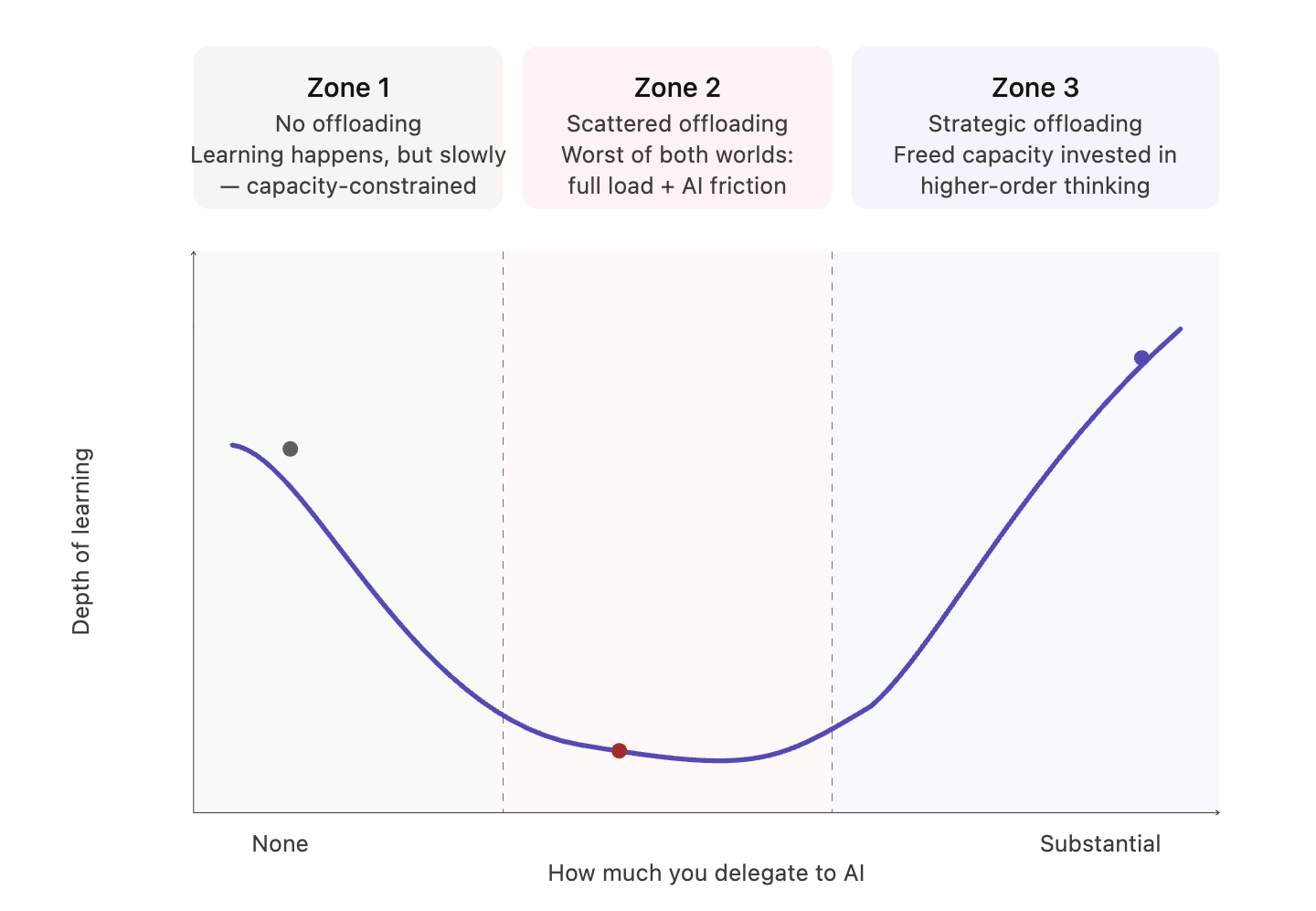
Now here’s where I have to be honest, because this is exactly the kind of overclaiming I criticized Dr Hardman for earlier. Wang & Zhang used Likert scale self-reporting — students rating their own perceptions of offloading and their own sense of transformative learning. That’s not the same as a controlled experiment measuring actual cognitive outcomes before and after. The mechanism they describe is plausible, theoretically coherent, and remarkably consistent across three very different cultural contexts. But nobody has yet run the study that would actually confirm it. What Wang & Zhang give us isn’t proof — it’s the strongest possible signal that the correct experiment has yet to be conducted. And when it is, I have a feeling I know which way it’s going to go.
But what about real life? Excellent question.
Part 2: Professional Offloading
Over the past 10 minutes or so, you may have been wondering why I’m making such a fuss about cognitive processes and whether generative AI makes you smarter or dumber. This is now going to be the part where I give you a reality check — because if you live, like me, in the education world, chances are you don’t really hang out with many AI “power users.” I’ll define that term in a minute.
If you haven’t been paying close attention to how people are actually using AI, you’re probably unaware of the reality taking shape among heavy users right now. You’re stuck in 2024 — AI helps you write emails, polish reports, maybe do some homework. You’ve fallen behind, my friend. I say this with some authority, because I know very few people who use AI more deliberately than I do, and I already feel like I’m falling behind. It just doesn’t stop.
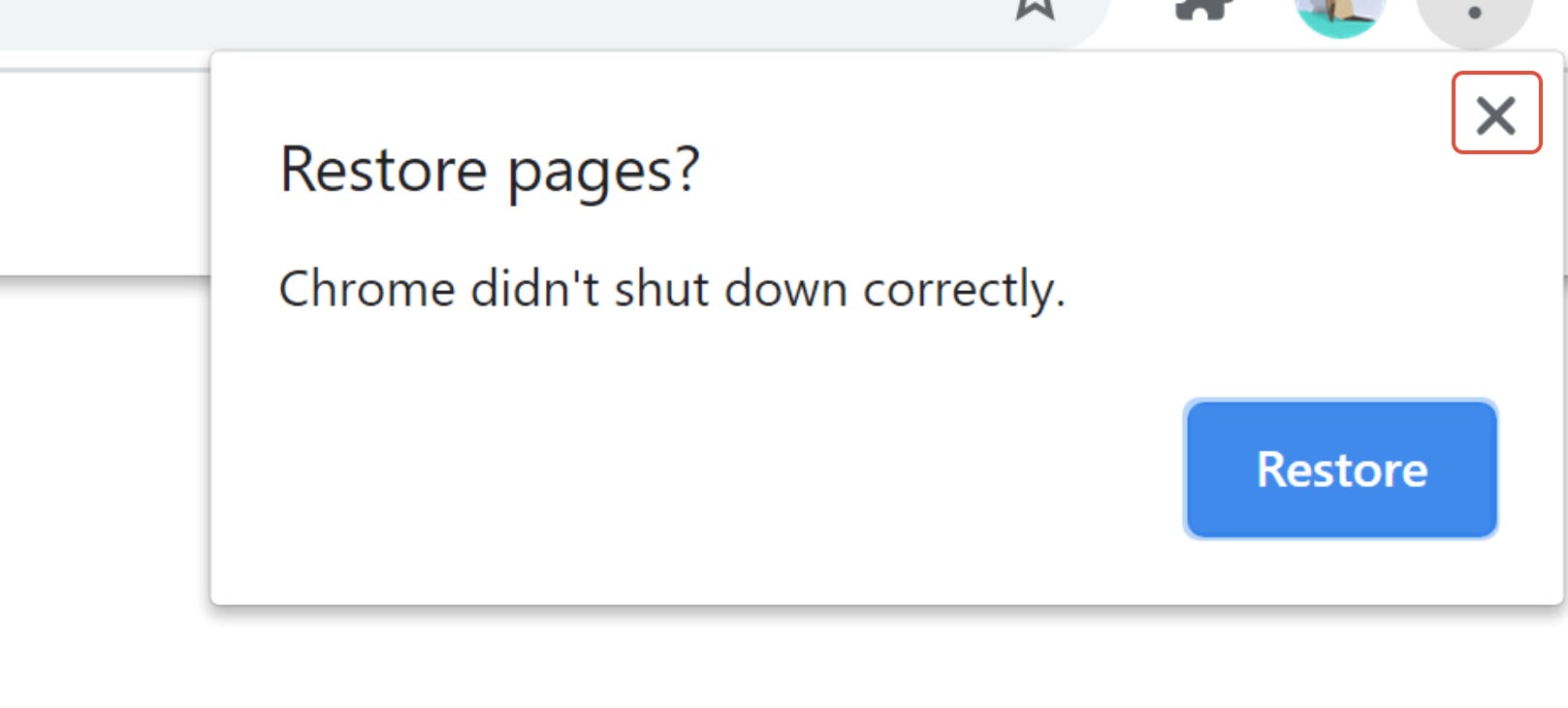
In any knowledge work context today, your computer is always on, your browser always running, with a minimum of five tabs open at any given time. Email, calendar — that’s the bare minimum. Add Slack, Salesforce, Monday, or whatever your organization runs on, and at least one AI tab in the mix. You keep all of this running in parallel in your brain, and you’ve come to depend on it to organize your thinking. That dependence shapes the way you work. That’s why, whenever your browser shuts down unexpectedly — likely because of an update — you can physically feel the relief when you see this message pop up.
Once AI becomes part of that stack, counting how often you use it becomes as meaningless as counting your emails. My entire workflow depends on email whether I send two messages in a day or two hundred. The same logic applies to AI. When it’s so integrated that you reach the end of the day unable to say how many prompts you used, you’re approaching the heavy user category. Not yet the power user — but closer.
Personal Knowledge Management
If that email analogy landed, you’re ready for a concept that may be new to you: Personal Knowledge Management tools, or PKM. Email and calendars are technically PKM tools — just ones so universal we don’t think of them that way.
If you use AI with custom GPTs, Gems, or Claude Projects, and you regularly dig through past conversations to pick up where you left off, you’ve already been using your AI platform as a kind of PKM — a place to store ideas, track projects, and streamline workflows. Same goes if you keep a physical notebook (like I do) or live in Google Docs. You’re offloading cognition, because you simply can’t work efficiently without doing so.
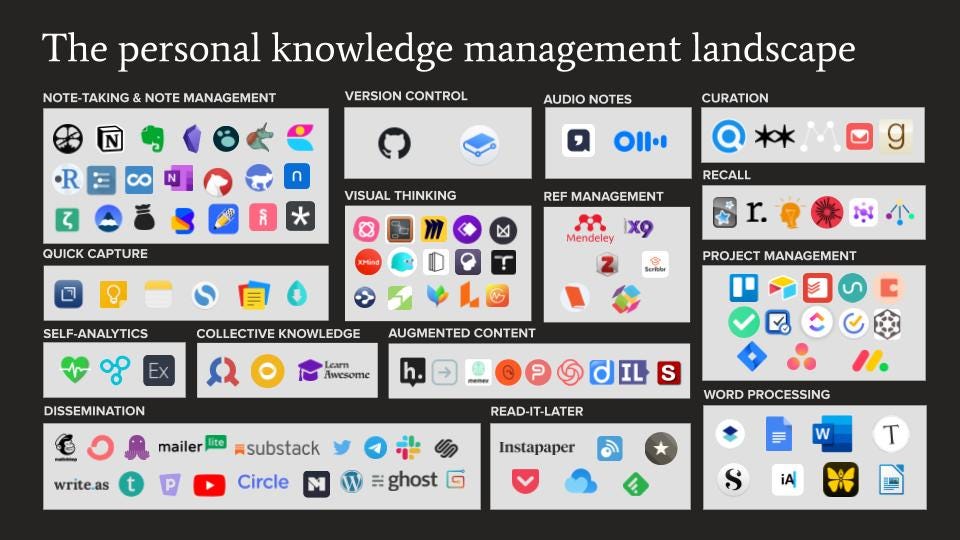
About a year ago, I started feeling like my existing tools weren’t keeping up with the volume of ideas I was trying to track — articles I wanted to write, sources I wanted to cite, threads I didn’t want to lose, and how they all related to each other. So I did what anyone does: I looked it up. I didn’t yet have the vocabulary for what I needed, but plenty of people before me did, and they’d built entire ecosystems to address it. I downloaded Obsidian, took one good look at the learning curve, and promptly closed it. I settled on Notion, which I’ve been using steadily since — though I’m the first to admit I’m not close to a power user of it either. Reimagining how you professionally think in your 40s isn’t trivial. I’m glad I started, and I’ll keep going.
The point is this: using technology to extend your cognition is neither new nor controversial. In knowledge work, it’s the name of the game. It’s what separates the efficient knowledge worker from the inefficient one: their capacity for what Guo & Ye, in their March 2026 Nature paper, call “duplicative offloading: supplementing internal processing with external support.” (p. 34)
That ecosystem I stumbled into — all those PKM tools built before AI existed — has now fully integrated with generative AI. Notion has a built-in assistant that’s genuinely useful. But more than that: I can give Claude the keys to my Notion workspace and have it go work in there on my behalf. When your PKM can talk back, take initiative, and execute tasks while you think about something else, you’ve crossed into different territory entirely.
Which brings me to why Andrej Karpathy’s April 2nd tweet hit over 20 million impressions.

If the name doesn’t ring a bell: he’s a 39-year-old who likes to write code and talk about it. He co-founded OpenAI, served as Director of AI at Tesla, and coined the term “vibe coding.” He is, without overstating it, a rock star of AI and software engineering. What he shared that day is now being called Karpathy’s Second Brain, or Karpathy’s Method, and YouTube tutorials on how to replicate it are multiplying by the week.
I don’t expect every reader to understand the technical details. What I do want to impress upon you is that a significant and growing number of people are already working this way2 — and a great many more feel the pull toward it without yet having the words for it. AI in your workflows isn’t just turbocharging productivity. It’s turbocharging this entire trend: cognitive offloading as a skill, or even a service.
Who are these people, and how many are there?
In March 2026, Harvard Business Review published the findings of a study conducted by University of Texas researchers in partnership with KPMG — one of the world’s largest professional services firms. Over eight months, they analyzed more than 1.4 million AI prompts generated by 2,500 employees3. Their goal was simple and long overdue: define what sophisticated AI use actually looks like, because nobody had done it yet.
What they found is that most organizations are measuring the wrong thing entirely. Frequency of use, hours logged, number of prompts — these are the metrics companies default to because they’re easy to count. But the study is unambiguous: they measure activity, not sophistication or impact. And in the absence of better signals, leaders struggle to offer any concrete guidance on how employees can actually improve.
So what does sophisticated use look like? Four behavioral patterns emerged consistently among the top users. I’ll let the authors speak here, because this deserves to be read carefully.
Sophisticated users were ambitious in how they approached AI — longer interactions, more back and forth, longer and more involved initial prompts, intentional switching between models depending on the task. They treated AI as a reasoning partner — shaping the model’s thinking through role definition, iterative refinement, and self-verification, rather than accepting the first output at face value. They delegated complex, multi-step tasks with clear objectives and success criteria. And they treated AI as a general cognitive tool rather than a narrow productivity shortcut — using it across ideation, analysis, technical guidance, and problem-solving alike.
That last one. Read it again. “A general cognitive tool rather than a narrow productivity shortcut.” That is the clearest institutional confirmation of cognitive superloading that I’ve seen outside of academic research. And it comes from 1.4 million real prompts, at a real company, over eight months.
What sophisticated users do — and why it sounds familiar
Here’s what strikes me about those four patterns when I read them as an educator: they don’t describe AI skill. They describe a cognitively sophisticated person.
Framing problems clearly. Guiding reasoning iteratively. Evaluating outputs critically. Switching approaches based on context. Delegating with precision. These are not things you learn from an AI tutorial. They are downstream consequences of having spent years thinking hard about hard problems and being held accountable for the quality of your reasoning. In other words: metacognition. And metacognition, as any educator knows, comes from experience — in the task itself, and in leadership, delegation, and teaching.
This maps almost perfectly onto what Wang & Zhang found in the research we discussed in Part 1. The students who generated the best learning outcomes were the ones who approached AI with vigilance and strategic intentionality — critically evaluating what the AI produced while deliberately delegating lower-order work. Different context, same human variable. The KPMG study didn’t set out to confirm a pedagogical theory, but it did anyway.
There’s one more detail in the behavioral portrait worth pausing on. The sophisticated users weren’t trying to save time, at least not in any immediate sense. Their interaction patterns — the length, the scrutiny, the iterative refinement — suggest people genuinely trying to achieve the best possible result. They were using their metacognitive skills, their leadership instincts, their capacity for teaching, to handle the AI the way a senior partner handles a talented but unpredictable junior: with high expectations, close oversight, and zero tolerance for output that doesn’t meet their standard. That standard exists because they already know what good looks like. The AI doesn’t get to define it. They do.
The seniority finding — and what it actually means
Now, get a load of this: only 5% of KPMG’s employees qualified as sophisticated users. At a firm that recruits from elite universities, where the incentive to perform is explicit, the culture is competitive, and the stakes are high. 90% of employees were using AI regularly. Only 5% were using it well. And in organizations less selective than KPMG, that number is almost certainly lower.
The authors describe their next finding as surprising. I don’t think it is. The best users skewed senior, not junior. Conventional wisdom says younger employees are more comfortable with these tools and adopt them more naturally. The study draws a sharp distinction between comfort and sophistication. Junior employees were more likely to use company AI tools for personal tasks. Employees above manager level were more likely to use AI for a broader diversity of work — technical guidance, ideation, complex analysis — and more likely to bring a deliberate strategy to the interaction.
The authors frame this as a seniority effect. I’d frame it differently: it’s an incentive structure effect. Everyone, at every level, is probably using AI for personal goals to some extent. What differs is how aligned those personal goals are with the company’s. A senior manager at KPMG who has spent fifteen years building toward partner has skin in the game that a first-year analyst simply doesn’t yet. Their personal ambition and the firm’s objectives have converged enough that superloading in service of one is superloading in service of the other. The junior employee’s goals are their own — and good for them! But the incentive to invest deeply in the firm’s problems hasn’t fully materialized yet.
Here’s what that means for the job market, and why every secondary educator should pay attention: the profiles who figure out how to align their superloading with organizational goals will become extraordinarily valuable. Rare now, but the doors are wide open.
The productivity paradox — and why it’s actually good news
Here’s something confirmed by multiple research teams in the past year, and that I’ll confess I’m living personally: AI power users paradoxically end up working more hours, not fewer. A UC Berkeley study published in early 2026 followed around 200 employees over eight months and found that heavy AI adopters worked at a faster pace, took on broader scope, and extended their work deeper into the day — often filling what used to be downtime with new projects. No net time savings. Sometimes more fatigue. But here’s the thing: they reported doing it voluntarily, because the work felt more interesting.
I get it. When you can finally tackle the things you’d been tabling for months because they were too big, too complex, or too time-consuming to even start — you start them. The ceiling on your ambition goes up, and you reach for it.
This is the bridge between offloading and superloading. Offloading frees capacity. What you do with that capacity is the whole question. Most people, reasonably, use it to breathe. A smaller group uses it to think bigger. And that group — I want to be precise here — is not doing something that requires special genius. They’re doing something that requires intentionality. That’s an important distinction.
Part 3: Cognitive Superloading
That’s what Karpathy’s tweet was about. Not a new concept. A new threshold. When your second brain does talk back, prioritize for you, make connections you hadn’t made, and execute tasks in other tools while you think about something else — you are no longer offloading cognition. You are superloading it. Tools like Claude Cowork are now putting this within reach of people who have never written a line of code in their lives. Instruct your AI in plain English, have it work across your files, your calendar, your drafts, and come back to you with results. The freed-up time goes directly into higher-order thinking. Wang and Zhang would recognize this immediately.
This is not a future concept. It’s happening now. And the people doing it have what I can only describe as cognitive superpowers relative to those who aren’t — not because they’re smarter, but because they’ve dramatically increased the bandwidth of what one person can think about, track, and act on at once.
What superloaders actually do — and why it matters for the job market
This is my read of where things are going, based on what I’m seeing and the conversations I’m having. I don’t have eyes inside every corporation. But the pattern seems consistent enough to be worth naming.
The first thing most people do when they start genuinely superloading isn’t to reinvent their own job. It’s to understand everyone else’s. Horizontal upskilling happens first because it’s the path of least resistance — it’s far more natural to use your freed-up cognitive bandwidth to get a feel for adjacent roles than to fundamentally rethink your own. You start doing things that used to require a different department, a different hire, a different budget. You see the connective tissue between functions that previously lived in silos.
Some people stop there, and that’s genuinely valuable. But a smaller group takes the next step: they start asking what the organization itself should look like if everyone had access to this extra cognition. They redesign workflows, collapse roles, identify where human judgment is genuinely irreplaceable and where it was never really the point. These are the people who will shape what the job market looks like in ten years. Not the AI companies. The individuals inside ordinary organizations who figured it out first.
And here’s what strikes me about this: it is profoundly democratic. There is no credential for it. No one has a monopoly on being the person in their workplace who figures out how to superload. It doesn’t require a computer science degree. It doesn’t require being 25. It requires curiosity, intentionality, and a willingness to sit with the discomfort of rethinking how you work.
Far be it from me to judge anyone who saves two hours a day with AI and spends them watching a movie or playing with their kids. I mean that sincerely — and that too is within anyone’s reach. But if I’m an employer with a position to fill and two candidates in front of me, one from each category… there won’t be any hesitation. Recruiting a superloader that has professional interests aligned with my company’s activity will feel like hitting the jackpot.
Back to School
I want to be honest here, I place myself squarely in the same category as most of my readers. I am not a superloader. I’m somewhere in the heavy-user zone, feeling my way toward something I can describe more clearly than I can execute.
The KPMG study concludes that sophisticated AI use is “observable, teachable, and scalable.” I want to believe that. But I’d push on it. What the study actually found — and doesn’t quite say — is that sophisticated use requires something to push back with. The senior KPMG manager scrutinizes the AI’s output because they’ve spent years developing judgment about what good looks like in their field. That prior knowledge is what makes the scrutiny real, not performative.
But here’s what I’ve realized: domain expertise isn’t the only thing that generates that scrutiny. Investment does the same work. A student who knows nothing about formal economics but is obsessed with sneaker resale markets will push back on an AI’s take on supply and demand with exactly the same rigor a KPMG partner brings to an audit memo. The expertise is real. It’s just not credentialed. Which means the condition for superloading in students isn’t a curriculum. It’s a reason to care.
Here’s what I’ve also come to understand about the people who are genuinely superloading in the workplace: they didn’t start with a master plan. Nobody sat down one day and decided to revolutionize their industry. What happened is more ordinary — and more instructive. They started using AI regularly. They integrated it gradually into their habits of mind. They followed developments, experimented, iterated. One process got better, then another, then another, and one day something clicked. An idea formed that wouldn’t have been possible before. They got excited. They wondered if they could pull it off.
That’s the actual story of a superloader. Not a vision. A practice.
Which means the school system probably can’t manufacture these people — and I’d be skeptical of anyone who claims otherwise. But we can do something that matters just as much: make this world visible. Show students it exists. Show them the door isn’t locked and nobody is standing in front of it checking credentials. Find the people in your communities who are living this — whether they succeed spectacularly or stumble publicly — and point to them. Name them. Celebrate the attempt.
That’s how we’ll teach a revolution.
I’ve been using em dashes long before chatGPT was here, I’ve always been pompous this way, AI ain’t gonna stop me.
At this stage, the heaviest concentration of power users is in one profession: software engineering. This is not a coincidence. When you use AI to write code, the feedback loop is binary and immediate — either the product runs or it doesn't. You don't need a PhD in epistemology to evaluate the output. And if it works but works inefficiently, you have clear metrics for that too: token consumption, compute cost, processing time. The whole thing is self-verifying in a way that almost no other knowledge work is. That's why developers cracked this first — they had the strongest incentive to delegate aggressively and the clearest signal that it was working. The rest of knowledge work is catching up, but slowly, because evaluating AI-generated thinking requires the very expertise you're trying to augment. The metric isn't binary. A paragraph can be technically correct and completely wrong for your purposes.
I am VERY curious how they did this. They only mention using GPT o1 to analyze all 1.4 million prompts and responses. All we have is this quote: “The analysis, which required extensive compute time, produced over 50 variables, which we then refined.”
La principale chose que j'ai envie de retenir :" ...where human judgment is genuinely irreplaceable"; "These are the people who will shape what the job market looks like in ten years. Not the AI companies. The individuals inside ordinary organizations who figured it out first."-
Merci de nous rappeler que nous restons indispensables et que ce sont des humains “ordinaires” qui vont et peuvent faire la différence (la force du pouvoir de l'intention, avant même qu'il soit question d' IA, d'ailleurs...).
Merci pour cette vision encourageante et démocratique de l’IA. Cela dit, même entre ces superloaders, il y aura des intentions très différentes. L’histoire nous l’a montré : la technologie amplifie ce que nous sommes. Espérons que la majorité utilisera ces "superpouvoirs" avec sagesse..........Mais c'est un autre (et vaaaaste) débat, n'est-ce pas ? ;)
You should take the AIcred test ... https://aicred.ai/